Jada Burns the Photos Decker Sent
The ExceptionJada’s burning of the photographs Decker sends her makes a private decision visible: she will not let the marriage she escaped reclaim the present she is building with Cane. The parcel brings back specific images of a shared life, but after confronting Decker by phone, Jada chooses to destroy them rather than treat nostalgia as a reason to return.
The parcel and the life it recalls
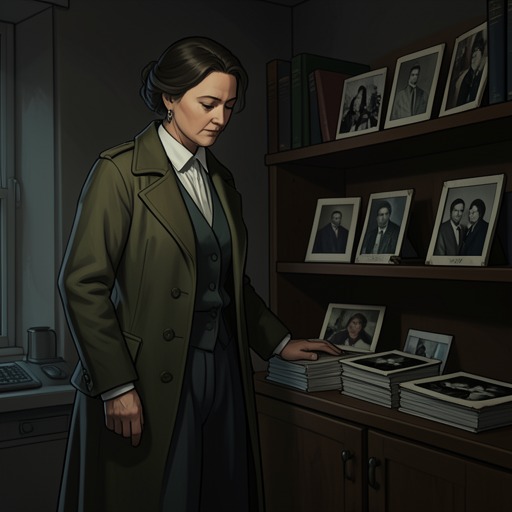
The photographs arrive in an unmarked, nondescript box while Kari is making spaghetti after a productive day that included shopping and buying a new dress. Jada has not ordered anything. When she opens the parcel at the table, she finds pictures she had left in the back of Decker’s closet. Their arrival interrupts an ordinary evening with images of a life she had tried to leave behind.
The photographs span different stages of the marriage. One shows Jada and Decker at Tempe Town Lake Marina when they were in college: he is smiling at her, while she smiles toward the camera. A blurry photograph of their small wedding ceremony is torn around the edges. Another shows their first house in Boston, which they had chosen after seeing it on a rainy summer day. Jada remembers being proud of that house. Together, the pictures preserve not only a relationship but the earlier hopes and shared milestones that make its later collapse harder to reduce to a single moment.
The history behind the images
For Jada, the pictures cannot be separated from the instability of her marriage. Decker could be considerate and bring home takeout, then become furious and verbally abusive. His unpredictability left her afraid of what might happen when he came home and confused about whether to leave. He also used her insecurities and fears about starting over to draw her back whenever she found the nerve to go.
The decisive break came when Jada discovered Decker’s affair with their neighbor. Although she had suspected his cheating for a long time, witnessing it ended her uncertainty. She moved her belongings to a friend’s home because she was unsure how Decker would react, and he subsequently alternated between pleading for her return and cursing at her. He continued to fight the divorce. The box therefore returns Jada to a marriage shaped by more than affectionate memories: it also recalls the fear, manipulation, and prolonged struggle to leave that made those memories difficult to trust.
Refusing Decker’s attempt to reopen the past
Jada reads a paper associated with the package. Its contents are not disclosed in full, but she recognizes a pattern in its tone: an apparently sweet beginning gives way to the behavior she remembers from Decker. She contrasts that confusion with the more dependable experience she has had with Cane, which she does not want to lose. Her response is mixed—annoyance, frustration, and some sadness—but she is clear that those feelings are not enough to make her act on Decker’s overture.
A call from Decker sharpens that decision. When he disparages Cane and suggests that Cane is influencing her, Jada answers that Cane shows her who he is rather than needing to persuade her with words. She ends the call and waits for Decker’s repeated call to stop before turning off her phone. With Kari’s help, she blocks the number, though Kari notes that the block applies to that number only. Jada’s response marks a change from the marriage in which she had struggled to defend her own judgment: she rejects Decker’s framing and takes a practical step to limit his access to her.
Burning the photographs
Jada looks back at the box and asks Kari for matches. She proposes a fire on the patio, with the photographs as kindling. The action is planned rather than an impulsive response to the parcel: after opening it, remembering the past, reading the paper, and cutting off the phone call, she chooses what to do with the objects that have brought that past into the house. The photographs do not disappear by accident or remain stored away for another possible return; Jada burns them.
The fire gives her decision a physical form. The pictures had held several versions of the shared life—the college couple, the newly married pair, and the proud owners of a first home. Destroying them does not erase that those events happened, and the evidence does not suggest that Jada’s memories or pain vanish with the paper. Instead, the act refuses to let the artifacts stand as a claim on her future. When she later explains the smoke to Cane, she describes it as her life before him going up in flames.
Disclosure, protection, and autonomy
The burning also becomes part of a later confrontation involving Decker and Cane. Cane is angry that Jada did not tell him about Decker’s call. Jada explains that she had already confronted Decker and burned the photographs he sent, but had not wanted to create drama over something she thought she had handled. Cane’s anger shows that the act does not settle every question between them: her decision to manage contact herself meets his expectation that he should be told. Jada acknowledges that she might have told him, but her explanation preserves the reason she acted independently.
That tension belongs to a broader conflict around Cane’s attempts to protect her. He had declared that none of his properties would be available to Simon Powers and asked Mr. Stanley to reassign Simon after the buyer made an offer on Solomon Place. Jada had called Cane’s refusal unreasonable. Her encounter with Simon also gives the issue real stakes: she pulled away when he touched her, refused his invitation, and later threatened to scream when he restrained her. These events do not explain Decker’s parcel, but they clarify why protection and personal agency remain contested in Jada’s relationship with Cane. Burning the photographs is her own boundary, made through her own choice; telling Cane about it afterward turns that choice into a point of negotiation as well as a declaration of release.